Risk warning:CFDs carry a high risk of rapid losses due to leverage. Only trade what you can afford to lose. Grades and scores are indicative, not a guarantee or financial or legal advice. Read moreCFDs carry a high risk of rapid losses. Grades and scores are indicative, not a guarantee or financial or legal advice. Read more
60% to 77%: what brokers' published loss figures tell you, and what they leave out
Every UK and EU CFD provider must publish the share of its retail accounts that lose money. We collected nine firms' current figures and read the rules that produce them.
Published loss figures across the nine firms we checked
60% to 77%
Period each figure covers, recalculated every three months
12 months
Standard range a firm must show if it has no recent CFD clients
74% to 89%
Every CFD promotion from a UK or EU provider carries a sentence of the same shape: a percentage, followed by “of retail investor accounts lose money when trading CFDs with this provider.” It reads like boilerplate. It is not. Each firm has to calculate the number for its own clients, under the same rules, and update it every quarter.
On 7 October 2026 we read the figure each of nine firms was publishing on its own website, and noted the regulated company each figure belongs to.
Nine firms, one sentence
Firm (regulated company)
Regulator
Published figure
Products named
Saxo (Saxo Capital Markets UK Ltd)
FCA
60%
CFDs
Capital.com (Capital Com (UK) Limited)
FCA
65%
Spread bets and CFDs
IG (IG Markets Ltd, IG Index Ltd)
FCA
70%
Spread bets and CFDs
IC Markets (IC Markets (EU) Ltd)
CySEC
73.46%
CFDs
Pepperstone (Pepperstone Limited)
FCA
73.6%
Spread bets and CFDs
XTB (XTB Limited, UK)
FCA
74%
CFDs
Pepperstone (Pepperstone EU Limited)
CySEC
74.1%
CFDs
OANDA (OANDA Europe Limited)
FCA
76.6%
CFDs
XTB (XTB Limited, Cyprus)
CySEC
77%
CFDs
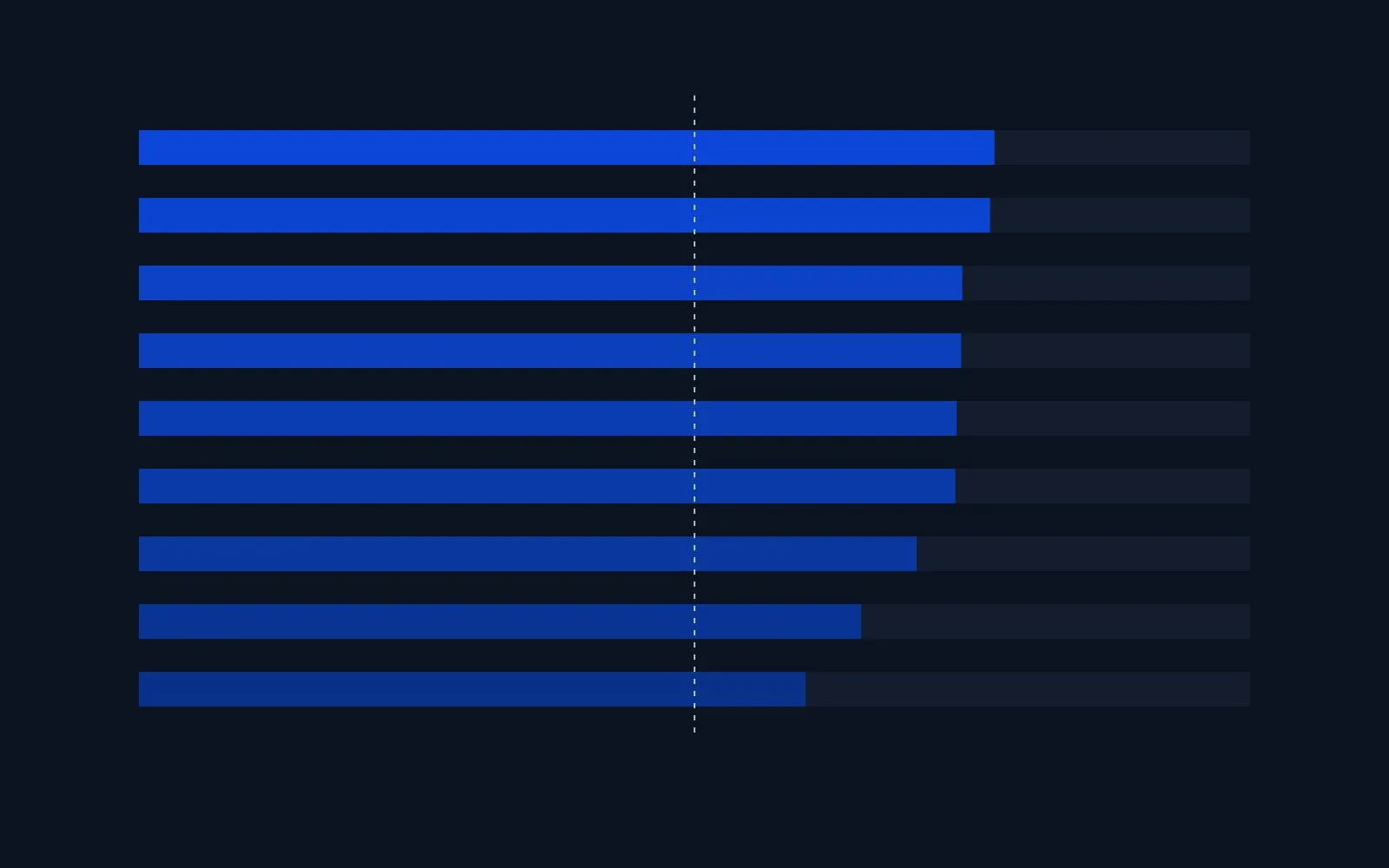
Share of retail accounts that lose money, as published by each firm (%)
Item
Value
XTB (CySEC)
77.0%
OANDA (FCA)
76.6%
Pepperstone (CySEC)
74.1%
XTB (FCA)
74.0%
Pepperstone (FCA)
73.6%
IC Markets (CySEC)
73.5%
IG (FCA)
70.0%
Capital.com (FCA)
65.0%
Saxo (FCA)
60.0%
Figures as shown on each firm's website on 7 October 2026, rounded to one decimal place in the chart. Each firm recalculates its own figure every three months.
Source: Firms' websites; see Sources
In every case, more than half of the firm’s retail accounts lost money over the period measured. The two firms with separate UK and Cyprus companies, Pepperstone and XTB, publish a different figure for each, because each company calculates its own.
How the number is calculated
The wording and the method come from the measures Europe’s regulators adopted in 2018, which national regulators then made permanent. The Central Bank of Ireland’s measure sets them out in the same terms as the others. The risk warning “shall include an up-to-date provider-specific loss percentage based on a calculation of the percentage of CFD trading accounts provided to retail clients by the CFD provider that lost money.” The calculation “shall be performed every three months and cover the 12-month period preceding the date on which it is performed.”
The measure then defines what counts:
Loss means the net result over the year. An account has lost money “if the sum of all realised and unrealised net profits on CFDs connected to the CFD trading account during the 12-month calculation period is negative.”
Costs are included, “including all charges, fees and commissions.”
Some things are left out: accounts with no open CFD during the period, profits or losses on other products held in the same account, and deposits and withdrawals.
The UK rule, in the FCA Handbook at COBS 22.5.6R, works the same way. The firm’s figure must be “an up-to-date percentage based on a calculation of the percentage of retail client accounts held with the firm that lost money,” and the calculation “must be performed every three months and cover the 12-month period preceding the date of the calculation.” The UK rules also cover leveraged spread bets, which is why IG, Pepperstone and Capital.com name spread bets alongside CFDs in their figures.
What the figure tells you
It tells you how the firm’s own retail clients fared, measured the same way at every firm, over a recent 12 months. That is more than most marketing claims offer, and it is the same calculation whichever provider publishes it.
It also tells you whether the firm has a track record. A provider that has had no open retail CFD positions over the last 12-month period cannot calculate a figure, so the rules require it to use a standard warning instead: “Between 74-89 % of retail investor accounts lose money when trading CFDs.”
What it leaves out
It counts accounts, not money. The figure says what share of accounts ended the period down. It does not say how much they lost, or how large the winning accounts’ gains were.
It is not a ranking of brokers. Each firm measures its own clients, and clients differ in what they trade, how often and with how much leverage. A lower figure is not, on its own, evidence of a better broker; a higher one is not evidence of a worse one.
Two figures read on the same day may cover different periods. The rules require a recalculation every three months, but each firm runs its own cycle. Our table records what was published on one date.
It only applies where the rules apply. The EU measures restrict the sale of CFDs to retail clients “in or from” the country that adopted them, and the UK rules bind firms the FCA authorises. A group company licensed outside the EU and the UK, serving clients outside them, is not covered by these rules and does not have to publish this figure.
Where the 74% to 89% range came from
The standard warning’s range reflects the evidence regulators gathered before 2018. Citing ESMA, the Central Bank of Ireland records that a CySEC analysis of around 290,000 client accounts at 18 major CFD providers, from 1 January to 31 August 2017, “found that on average, 76% of client accounts made an overall loss over that particular period, with around 24% of client accounts in profit.” Spain’s CNMV found that about 82% of retail clients lost money over 21 months between early 2015 and late 2016, and France’s AMF that more than 89% did over four years from 2009 to 2013.
The nine figures we collected in October 2026 sit between 60% and 77%. Firms recalculate quarterly, so they will have moved by the next time anyone checks.
How to use it
Read the figure on the website of the company you will contract with. A group can have several regulated companies, each with its own number.
Treat it as one fact among several. Regulation, the protections that apply to your account, costs and how the firm handles withdrawals matter as much. Our audits check those for the firms we cover.
Remember what it describes: most retail accounts at every firm we checked lost money over a year.
Brazil's securities regulator has opened sanctions cases against nine foreign trading platforms since 2021, six of them between April 2025 and February 2026, and in August fined Pocket Option's operator R$3.9 million. We read the CVM's own records: who is named, what the penalties have been, how the CVM decides a platform is targeting Brazil, and what it means for traders and for the firms that court them.
A February 2026 statement tells firms that the commercial name of a leveraged derivative is irrelevant. What matters is whether it meets the definition of a CFD, and most perpetuals likely do.